
Italian style homes
· MAR DESIGN STUDIO
Italian, said loosely, covers two houses that should not be drawn as one. The villa is composed. The farmhouse was accumulated. They share a climate and a clay tile. They do not share a plan.
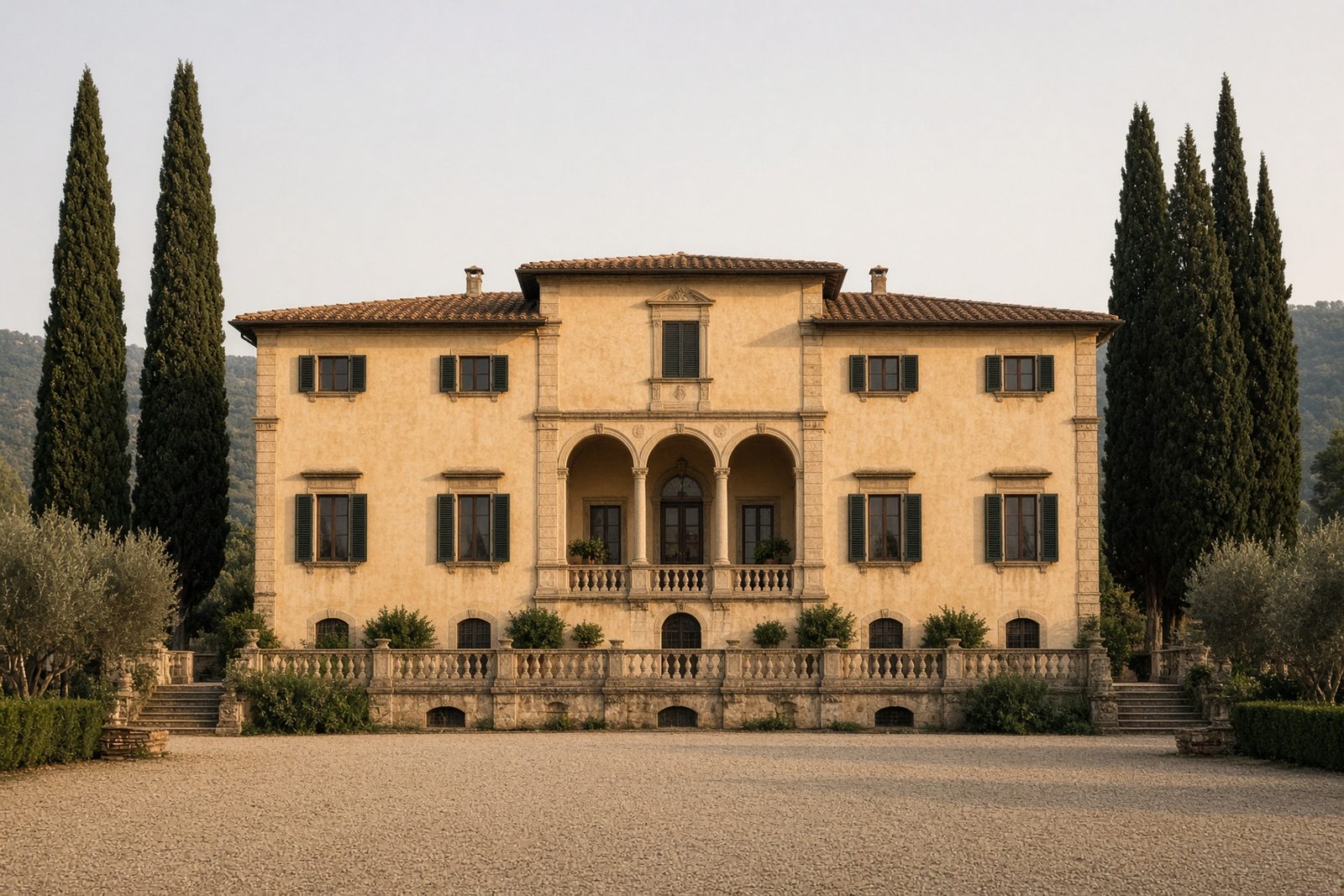
A face with a center
The villa is organized around a middle. Door in the center, openings paired to either side, the same number of windows left and right. One or two stories, sometimes a raised main floor, rarely a busy skyline. If a wing is added, it answers the wing opposite, or it is clearly subordinate.
Ochre, cream, or a pale stone color. Shutters, when they appear, are dark and simple. The ornament is measured: a molded frame, a balustrade, maybe a coat of arms' worth of carving and no more. A house that is Italian in this sense looks calm from the gate. Busyness belongs to another tradition.
Roof, cornice, and the line under the tile
The roof is clay tile, barrel or a flatter pantile, on a shallow pitch. It should not rear up into a steep gable. Under it, a stucco or stone cornice finishes the wall and throws a shadow. That crown is part of the style. An open eave with a row of shaped rafter tails is the Spanish habit, and it loosens a villa that was meant to look composed.
Cypress, a gravel court, and a terrace do more for the house than an extra dormer. The silhouette from the road is roof, cornice, wall, and two dark trees. If that reads clearly, the smaller choices can wait.
The loggia
A loggia is a roofed walk of arches, open on one side, usually facing the garden or the court. On a villa it sits on axis: you can stand in the door and see through it. The arches are round, or a quieter segmental curve, and they are deep enough to stand in shade.
This is the room the climate requires and the composition wants. Glass can close one bay in a hard wind. It should not replace the arches with a single sheet of wall-to-wall glazing and a token arch left over the front door.
The farmhouse is the other Italian
A casa colonica is stone or rough plaster, added room by room, with a tower that used to be a dovecote and a roof that changes pitch where a generation stopped. Its charm is the unevenness. Asking it to be symmetrical will sand that off. Asking a villa to look accidental will do the same in reverse.
Decide which house it is before the first elevation. Villa: symmetry, cornice, loggia, a garden on axis. Farmhouse: stone, a working court, a roof that is allowed to be imperfect. Mixing the two without choosing produces a house that is only vaguely warm-colored.
Illustrations made for MAR DESIGN STUDIO.
Ready to talk about a house?
Book a consultation