
Moroccan houses
· MAR DESIGN STUDIO
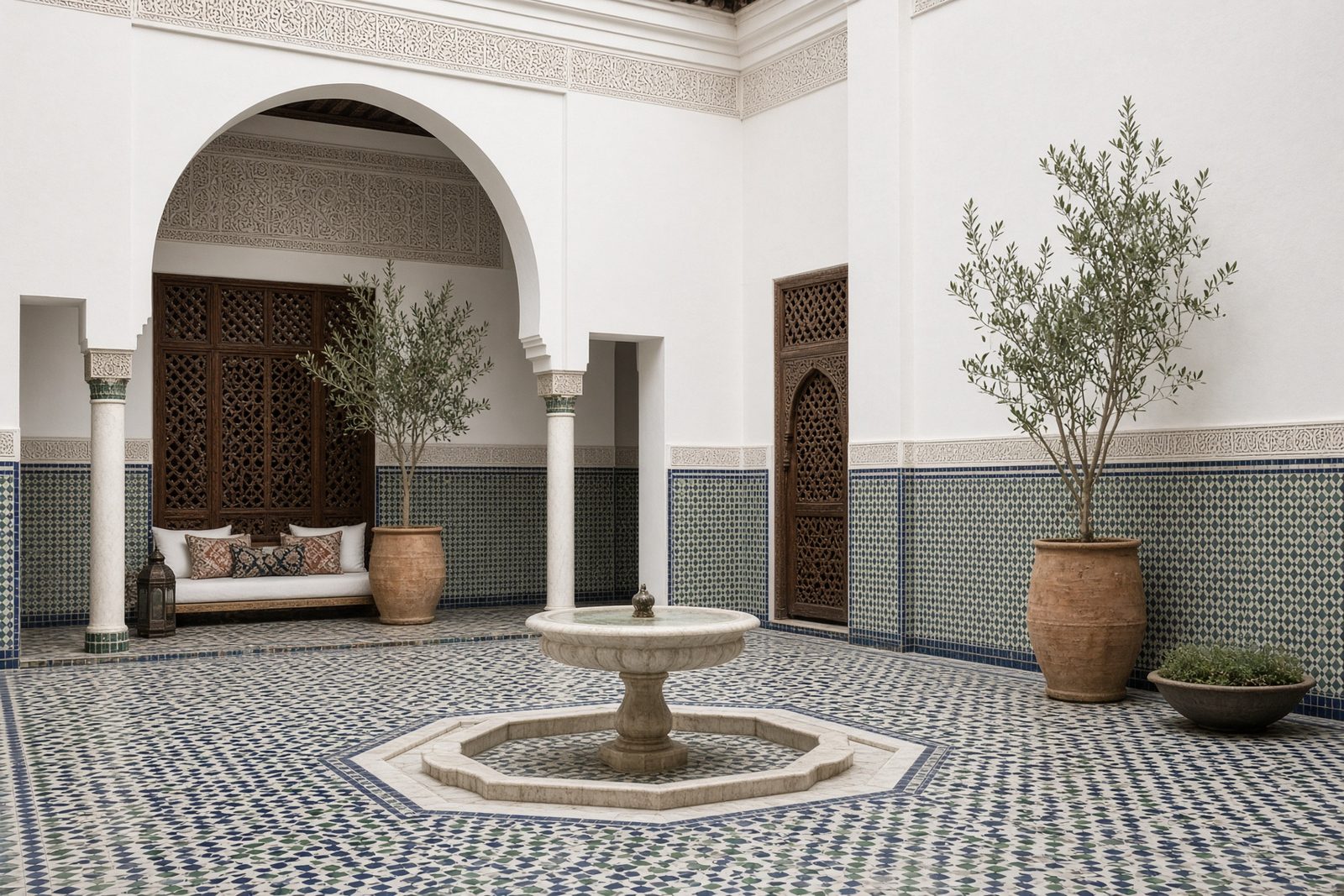
Moroccan building is not a Mediterranean villa with ornament added. The riad, the courtyard house of the old cities, turns its back on the street. Rooms look into a shaded court. The roof is often flat, a terrace for the evening, not a red tile slope.
An inward plan
From the alley you may see only a door in a long wall. Inside, a passage turns and then opens to the court, often with a fountain or a pool at the center and galleries around it. Privacy is the point, and so is light: the court is the window the street wall refuses to be.
That plan does not survive being stretched into a glass pavilion facing a view on all sides. A prospect who wants both a riad and a wall of ocean glass has to choose which one the house answers to. A terrace on the roof can take the view. The court still belongs in the middle.
The horseshoe, and the arches around it
The arch to ask for is the horseshoe: it narrows at the springing and rounds above it, so the opening is smaller at the bottom than at the belly. Multifoil arches, scalloped along the edge, show up at a niche or a fountain. A plain half-circle, which is right on an Italian loggia, looks unfinished here if every opening uses it and nothing else does.
Depth matters again. The arch should be thick, plastered, and aligned with the gallery it opens. A thin arch glued over a standard door frame is the fastest way to make the house look costumed.
Zellige, tadelakt, cedar
Zellige is the cut geometric tile, set in star and strapwork patterns, usually on a fountain, a lower wall, or a floor. It is not a backsplash running to the ceiling. Tadelakt is lime plaster polished with stone and soap until it is smooth and water-resistant, the finish of a bath and sometimes of a whole wall. It is a craft with a curing time, not a paint color called plaster.
Cedar shows up as a screen, a door, or a ceiling, often pierced so light comes through in a pattern. That screen, the mashrabiya when it is at a window, is how a room takes air without giving the street a view in. Use one of these materials thoroughly. Using all of them in every room turns the house into a catalog.
Color and the roof
Walls are plaster: white, sand, a pale rose, sometimes a deep blue in a court or on a door. The garden green is the other strong color, and it should be a plant, not a paint. Pattern stays low, on the tile and the carving, so the upper walls stay quiet.
Do not assume a barrel-tile roof. In the medina the roof is a terrace, edged by a parapet, used at night. A sloping clay roof can exist on a country house, but if someone asks for Moroccan and then insists on a Spanish tile roof, iron balconies, and a street-facing arcade, they have changed countries without saying so.
Illustrations made for MAR DESIGN STUDIO.
Ready to talk about a house?
Book a consultation